
Potentiation of Electrochemotherapy by Anti-PD-1 Immunotherapy in Murine Tumors with Distinct Immune Profiles
Authors: Masa Omerzel, Simona Kranjc Brezar, Ursa Lampreht Tratar, Tanja Jesenko, Barbara Lisec, Gregor Sersa, and Maja Cemazar

Authors: Masa Omerzel, Simona Kranjc Brezar, Ursa Lampreht Tratar, Tanja Jesenko, Barbara Lisec, Gregor Sersa, and Maja Cemazar
Type of contribution: Research manuscript
Abstract:
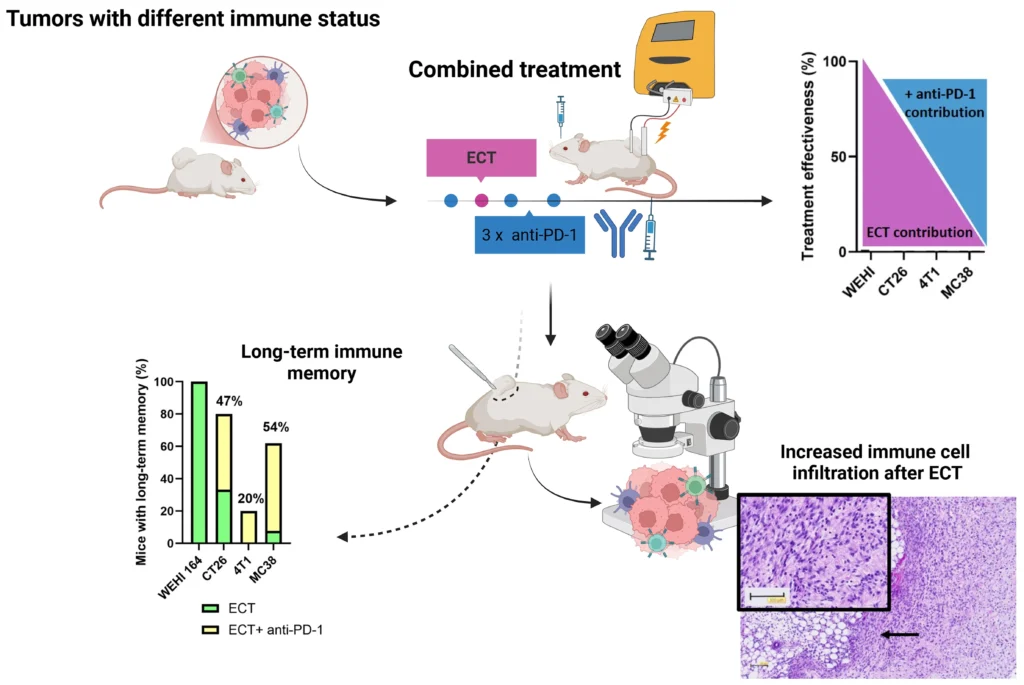
Background: Electrochemotherapy (ECT) is a clinically validated local ablative treatment increasingly recognized for its ability to induce immunogenic cell death and stimulate antitumor immunity. Its combination with immune checkpoint inhibitors, such as anti-PD-1 antibodies, may enhance systemic immune responses and improve therapeutic efficacy, particularly in poorly immunogenic tumors. Methods: We evaluated the antitumor effectiveness of ECT combined with a murine analog of the anti-PD-1 antibody in four syngeneic murine tumor models with differing histology and immune status: WEHI fibrosarcoma, CT26 and MC38 colorectal carcinoma, and 4T1 mammary carcinoma. In vitro cytotoxicity assays assessed tumor cell sensitivity to ECT, while in vivo experiments evaluated complete response (CR) rates, immune cell infiltration, and long-term immune memory through secondary tumor challenge. Immunohistochemical analysis of CD4+, CD8+, and granzyme B+ effector cells. Results: In vitro, WEHI cells exhibited the highest sensitivity to ECT. In vivo, ECT monotherapy induced CRs in 100% of WEHI tumors, 60% of CT26, 17% of 4T1, and 15% of MC38. The addition of anti-PD-1 significantly enhanced outcomes in less responsive models, increasing CRs to 90% in CT26, 91% in MC38, and 53% in 4T1. Combination therapy promoted pronounced infiltration of CD4+, CD8+, and granzyme B+ T cells and the formation of tertiary lymphoid structure, particularly in MC38 tumors. Secondary challenge experiments confirmed long-term immune memory in CT26 and MC38 models and induced memory in 4T1, which was absent following monotherapy. Conclusions: ECT synergizes with PD-1 blockade to potentiate local and systemic antitumor immunity, overcoming immune resistance in poorly immunogenic tumors. These findings support further clinical development of ECT in combination with immune checkpoint inhibitors as a component of personalized cancer immunotherapy.
Journal: Cancers